Before the First Trial Run: How Digital Twin Technology Is Transforming Sintering Process Development
The Empirical Inheritance
Sintering has always been, at its core, an empirical discipline. Process parameters — temperature profiles, atmosphere compositions, belt speeds, zone lengths — have historically been established through systematic experimentation, refined through trial and error, and encoded in institutional memory that lives on process sheets and in the minds of experienced engineers. The knowledge is real and often highly effective. But it is also slow to develop, expensive to acquire, and poorly suited to rapid iteration.
For manufacturers introducing new materials, new geometries, or new production equipment, the development cycle can stretch across weeks of physical trials, consuming powder, furnace time, and engineering hours. Each trial generates data, but the relationship between process inputs and part outcomes remains, for many practitioners, a black box — a domain where experience provides guidance but genuine predictive capability remains elusive.
Digital twin technology is now challenging that model directly.
What a Sintering Digital Twin Actually Does
The term "digital twin" is used loosely across manufacturing, but in the sintering context it refers specifically to computational models that simulate the thermal, chemical, and densification behavior of a sintering system with sufficient fidelity to generate actionable engineering predictions.
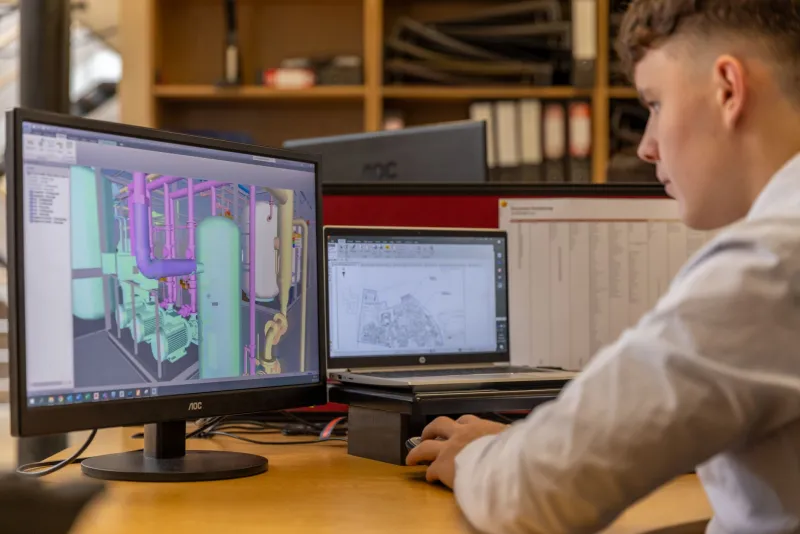
A well-constructed sintering digital twin can model heat transfer through a loaded furnace, accounting for part geometry, loading density, and thermal mass. It can simulate atmosphere gas flow and the chemical reactions that govern carbon control and surface oxidation. It can predict density gradients within a compacted part as a function of the thermal cycle applied. And — crucially — it can do all of this before a physical part is ever placed in the furnace.
The underlying physics is not new. Finite element analysis of sintering behavior has been an active area of academic research for decades. What has changed is the computational infrastructure available to implement these models at industrial scale, the quality of material property databases that feed them, and the software platforms that make them accessible to engineers without deep computational backgrounds.
Who Is Using This Approach
Adoption of sintering simulation tools is currently concentrated among larger powder metallurgy producers and the OEM customers who specify sintered components for demanding applications. Automotive Tier 1 suppliers, defense contractors, and medical device manufacturers — all of whom face stringent dimensional and mechanical property requirements — have the most direct economic incentive to invest in predictive process modeling.
Several commercial software platforms have emerged to serve this market. Companies including Simufact (a Hexagon company), ANSYS, and specialized PM simulation developers have all invested in sintering-specific modeling capabilities. Some OEMs and larger PM producers have developed proprietary simulation environments built on open-source finite element frameworks, tailored to their specific material systems and furnace configurations.
Among mid-sized and smaller sintering operations, adoption remains limited — a reflection of both cost and capability constraints that will be examined later in this article.
The ROI Case
The business case for sintering simulation is most compelling when framed around development cost reduction. A physical sintering trial at a mid-volume production facility might consume several hundred dollars in powder, atmosphere gas, and furnace time — plus the engineering hours required to characterize results. A complex new part development program might require dozens of such trials before acceptable process parameters are identified.
Digital simulation does not eliminate physical trials. But it can dramatically reduce their number by screening out parameter combinations that the model predicts will produce unacceptable outcomes. Early adopters report development cycle reductions in the range of 30 to 60 percent for new part introductions, with corresponding reductions in scrap and rework costs.
The value proposition extends beyond development. Manufacturers who have integrated digital twin capabilities into production environments report using their models to diagnose process drift, evaluate the impact of raw material lot variation, and assess the feasibility of throughput increases before committing to physical process changes. In each case, the model provides a structured framework for engineering judgment — not a replacement for it, but a meaningful augmentation.
The Fidelity Problem
Digital twin technology in sintering is not without significant technical limitations, and any honest assessment must engage with them directly.
The accuracy of a sintering simulation is fundamentally constrained by the quality of the material property data that feeds it. Sintering behavior is highly sensitive to powder characteristics — particle size distribution, morphology, surface chemistry — that vary between lots and between suppliers. A model calibrated to one powder lot may generate meaningfully different predictions when applied to another. This is not a software problem; it is a materials characterization problem, and it imposes real limits on the generalizability of simulation results.
Furnace-specific factors add further complexity. Heat transfer in an industrial continuous furnace depends on muffle geometry, heating element condition, loading patterns, and gas flow dynamics that are difficult to characterize with precision. Models built on idealized furnace geometries may diverge from observed behavior in ways that require empirical correction.
Leading practitioners address these limitations through a hybrid approach: simulation is used to narrow the parameter space and identify promising process windows, while physical trials are retained for validation and fine-tuning. The goal is not to eliminate experimentation but to make it more targeted and efficient.
Accessibility and the Mid-Market Gap
Perhaps the most significant structural challenge facing broader adoption of sintering simulation is accessibility. The cost of commercial simulation software, combined with the expertise required to configure and interpret models correctly, creates a meaningful barrier for smaller operations.
A sintering shop running ten to fifty employees and serving regional industrial markets may lack both the budget and the in-house technical staff to deploy and maintain a digital twin environment. For these companies, the technology remains largely theoretical — something they read about in trade publications but cannot practically implement.
Several potential pathways exist to address this gap. Cloud-based simulation platforms that reduce upfront software investment are beginning to emerge. Industry consortia and university partnerships offer another avenue, with some academic institutions making simulation capabilities available to industrial partners on a collaborative basis. NIST and DOE-affiliated laboratories have also been active in developing open-source sintering simulation tools intended for broader industrial access.
A Shift in How Engineers Think
Beyond the operational metrics, the deeper significance of digital twin adoption in sintering may be cultural. The shift from purely empirical process control to data-informed prediction represents a meaningful change in how sintering engineers frame their work — from reactive troubleshooting toward proactive design.
That shift is not instantaneous, and it is not without friction. Engineers who have spent careers developing process intuition through direct floor experience do not always find it natural to engage with computational models as a primary decision-making tool. Building confidence in simulation outputs requires a period of validation, and that validation requires exactly the kind of empirical trial work that simulation is meant to reduce.
But for organizations that have navigated that transition, the consensus is consistent: the ability to ask "what will happen" before committing to a process represents a fundamental improvement in how sintering development work gets done.