The Data Stops Here: Closing the Sintering-to-Machining Information Gap

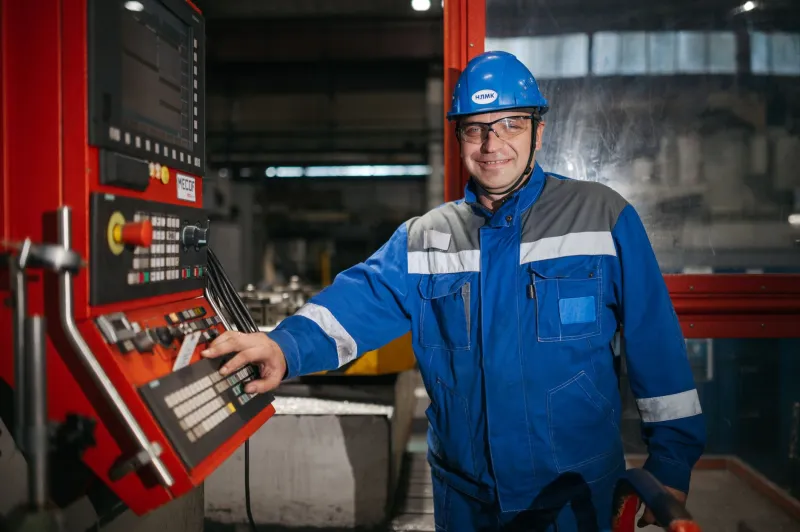
Photo: industrial sintering furnace control room data screens manufacturing, via uppolice.org
Sintering is a data-rich process. Furnace profiles, atmosphere readings, density maps, dimensional trends, and lot-level inspection results are produced every shift in plants across the United States. Yet in many organizations, that information expires at the department door. Machining receives a bin of parts and a traveler. Assembly receives a schedule. The customer receives a certificate of conformance. The process knowledge that could explain a downstream problem remains stranded upstream.
Where the Information Trail Ends
The breakdown is rarely dramatic. It is a series of small discontinuities. A furnace log lives in a spreadsheet on a supervisor's desktop. A density map is printed and filed. A dimensional trend is reviewed at shift meeting but not attached to the lot record. When a machining center reports chatter, a tool-life anomaly, or a dimensional drift, the investigation starts from zero because the upstream context was never transferred.
In a 2026 manufacturing environment that increasingly emphasizes digital thread and traceability, this gap is conspicuous. Sintering departments often have more process data than they can usar — and downstream operations often have less than they need. The result is a quiet inefficiency that does not appear on a downtime report but does appear in scrap rates, rework hours, and warranty claims.
The Cost of a Quiet Gap
Consider a common scenario. A sintered bearing lot exhibits slightly lower density near the flange. The sintering department notes the deviation but judges it within internal limits. The lot ships to machining, where the lower density translates into different cutting behavior: tool wear accelerates, surface finish drifts, and a handful of parts are scrapped. Machining attributes the problem to tooling. Sintering is never asked. The true cause — a density gradient that was known but not communicated — remains unaddressed, and the next lot repeats the pattern.
The cost is not limited to scrap. Warranty exposure grows when dimensional trends that were visible in sintering data only surface after assembly. In automotive and appliance applications, where sintered components often carry long service expectations, a missed handoff can take months to diagnose and years to recover from. The industry has spent considerable effort on furnace control and powder quality; the handoff between process steps deserves comparable attention.
What a Data Contract Should Specify
A data contract is not a software platform. It is an agreement between departments — and, where relevant, between a sintering supplier and its customer — about what information moves, in what form, and when. A practical contract for sintering-to-machining handoff should address at least the following elements.
Parameter set and format
Define which furnace parameters, density results, and dimensional characteristics travel with each lot. Specify units, sampling frequency, and whether data is summarized or raw. A machining supervisor does not need every thermocouple reading, but they do need to know the density range, the critical dimensional trend, and any process deviation that could affect machinability.
Timing and trigger points
Data that arrives after the parts have been machined is history, not information. The contract should state when data is transmitted — at lot release, at shift close, or immediately upon a process excursion. Exception-based triggers are especially valuable: if a furnace atmosphere deviates or a density result falls outside an agreed band, downstream should know before the lot reaches the machining center.
Lot linkage and traceability
Every data packet should be tied to a lot identifier that machining and assembly already use. Without a common key, even good data becomes difficult to use. The contract should also define retention periods and access permissions, particularly when suppliers and customers share responsibility for a component.
Change notification
Process changes upstream often appear downstream as unexplained variation. The contract should require notification of changes to powder supplier, furnace configuration, atmosphere strategy, or sintering cycle — even when those changes are believed to be neutral. A brief notification with a technical summary is sufficient; silence is the risk.
Feedback loop
A data contract that only flows downstream is incomplete. Machining and assembly should return scrap reasons, tool-wear observations, and dimensional findings to sintering. That feedback is the raw material for process improvement. Without it, sintering operates blind to its own downstream consequences.
Starting Small, Measuring the Gain
Plants that have closed this gap rarely began with an enterprise data initiative. They began with a single product family, a shared spreadsheet, and a weekly review. The first step is to map what data exists, where it lives, and who needs it. The second is to agree on a minimal transfer format. The third is to measure the effect: scrap rate, rework hours, investigation time, and warranty claims.
In 2026, the tools for this work are not the obstacle. The obstacle is organizational habit. Sintering data has value beyond the sintering department, but only if someone treats the handoff as a process in its own right. The parts already cross the door. The information should cross with them.