Gas, Power, and Water: The Sintering Process Variables Hiding in Your Facility
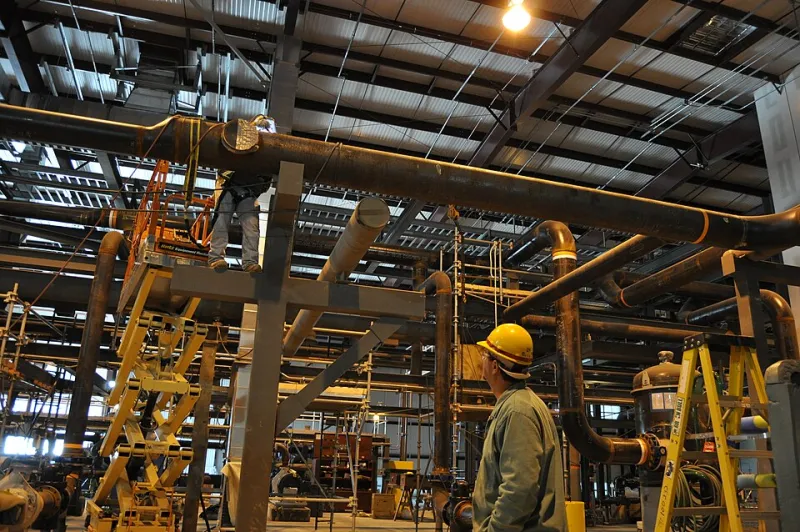
Photo: PEO ACWA, CC BY 2.0, via Wikimedia Commons
Sintering risk registers tend to look inward. They list furnace refractory condition, heating-element life, powder lot variability, operator training, and preventive maintenance schedules. These are legitimate concerns. But in many US plants, a parallel set of process inputs receives far less attention: the gas, electricity, and water that the furnace depends on. These utilities are treated as infrastructure — assumed to be stable until they are not. In practice, they behave like process variables, and they deserve a place on the risk register.
Utilities as Process Inputs
A sintering furnace does not run on setpoints alone. It runs on atmosphere gas delivered at a specified purity and pressure, electrical power delivered within a specified voltage and frequency band, and cooling water delivered at a specified temperature and flow. When any of these inputs drifts, the furnace may continue to run, but the process may not. The result can be subtle: a slight increase in oxygen content, a density gradient, a color variation, a dimensional shift. These are exactly the kinds of defects that are difficult to diagnose after the fact because the furnace log looks normal.
Gas purity and pressure
Atmosphere control is often discussed in terms of flow rates and dew point, but supply-side gas quality matters just as much. Nitrogen with elevated oxygen, hydrogen with moisture contamination, or a pressure swing during a peak demand period can alter the sintering environment. In plants that share gas supply with other processes, the sintering furnace may be the most sensitive user and the least protected.
Power quality
Voltage sags, harmonic distortion, and brief interruptions can affect heating-element performance, control-system stability, and conveyor drives. A furnace may ride through a disturbance without tripping, yet the thermal profile may deviate enough to affect densification. Power quality is rarely monitored at the furnace level, which means the evidence is often missing when a defect is investigated.
Cooling-water reliability
Cooling water removes heat from furnace shells, power supplies, and vacuum systems. Temperature excursions, flow restrictions, or pump failures can trigger alarms, but they can also produce conditions that degrade performance without an immediate trip. In summer months, when cooling demand peaks, water temperature and pressure are particularly important.
Where US Plants Commonly Underestimate the Risk
The underestimation is rarely a matter of ignorance. It is a matter of ownership. Utilities are often managed by facilities or maintenance, while process quality is managed by manufacturing engineering. The two groups may not share data. A gas-pressure excursion recorded by the utility provider may never reach the sintering engineer. A power-quality event logged by the building management system may not be correlated with a downstream dimensional trend.
Another common gap is assumption stacking. A plant assumes the gas supplier maintains purity, the utility maintains voltage, and the cooling system maintains temperature. Each assumption may be individually reasonable. Together, they can create a blind spot that no single function owns.
Building a Practical Utility-Risk Audit
A utility-risk audit does not require a major capital project. It requires a structured review of what the furnace needs, what the facility provides, and how deviations are detected and communicated. The following steps provide a practical framework.
1. Define the utility envelope
For each furnace or sintering line, document the required gas purity, pressure range, power quality tolerance, and cooling-water temperature and flow. This envelope should be based on process requirements, not on what the facility happens to deliver today.
2. Map the supply path
Identify where each utility enters the building, how it is conditioned, and what other users share the supply. A gas line that serves both a sintering furnace and a heat-treat operation has different risk characteristics than a dedicated line.
3. Identify monitoring gaps
Determine what is measured, where, and at what frequency. If gas pressure is monitored only at the bulk tank, the furnace inlet may see something different. If power quality is not monitored at the furnace panel, transient events may be invisible.
4. Correlate utilities with quality data
Where possible, compare utility events with furnace logs and inspection results. A pattern may emerge that was previously attributed to powder or operator variation. Even a simple log of utility excursions and defect occurrences can be informative.
5. Define response and communication
Specify what happens when a utility deviation occurs. Who is notified? Is the affected lot quarantined? Is the furnace load evaluated? The response should be documented and practiced, not improvised.
6. Review contracts and contingencies
Utility supply contracts often include quality commitments, but they may not be aligned with sintering requirements. Review them. Ask what notice the supplier provides for maintenance or curtailment. Identify backup options for critical utilities.
The Register Test
A simple test can reveal whether utilities are being taken seriously: open the risk register and search for gas, power, and water. If they appear only as general facility items, the process risk is likely understated. If they appear with defined envelopes, monitoring plans, and response actions, the plant has recognized that utilities are part of the sintering process — not merely the background against which it runs.